


Partner Site
Confidential

A new intelligence frontier is forming.
We are forging it.

Encoding the human brain, the last untapped resource.

The Intelligence Frontier — Human and AI Integration
Executive Summary

AI is forcing every organization to balance human and artificial intelligence. The usual responses (moving too late, striking the wrong human-AI balance, or integrating the two without a real method) are already failing in public. They fail for the same reason: human intelligence has never been codified, so it can't be deliberately integrated with AI. FiLiCiTi codifies human intelligence into quantifiable metrics and pairs it with AI in a live, closed-loop system, mining the brain, the last untapped resource of performance.

We believe the next 12 months are critical for small and mid-sized businesses. Those that wait risk being overtaken, but those that rush in without a proper integration risk sudden failure too.

The Intelligence Dilemma: Three Ways to Fail

Timing, balance, method. Miss any one and the bet collapses. It's already happening in public.

Every organization now faces the same question: how much to lean on human judgment, how much on AI. There are three ways to get it wrong.

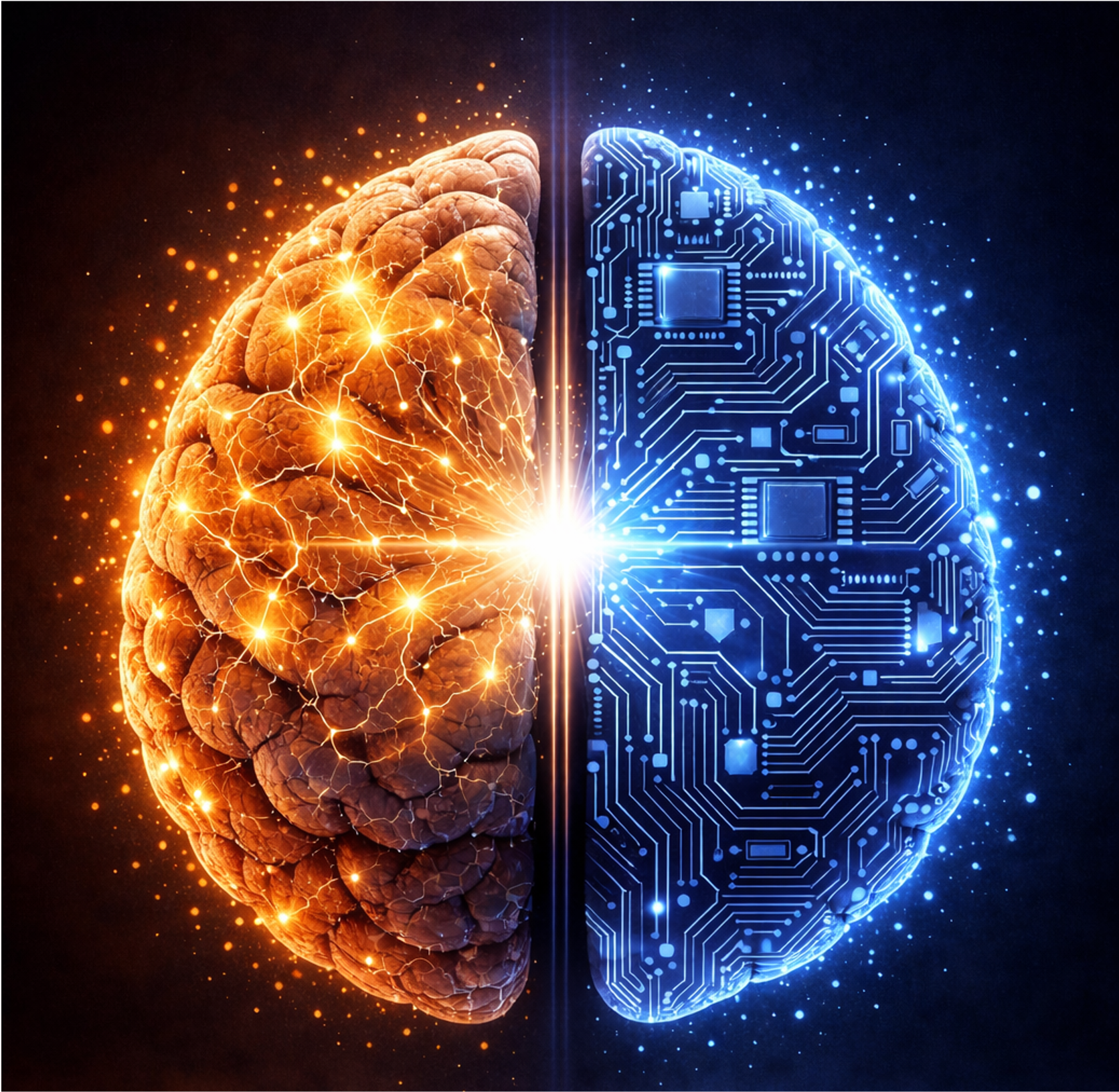
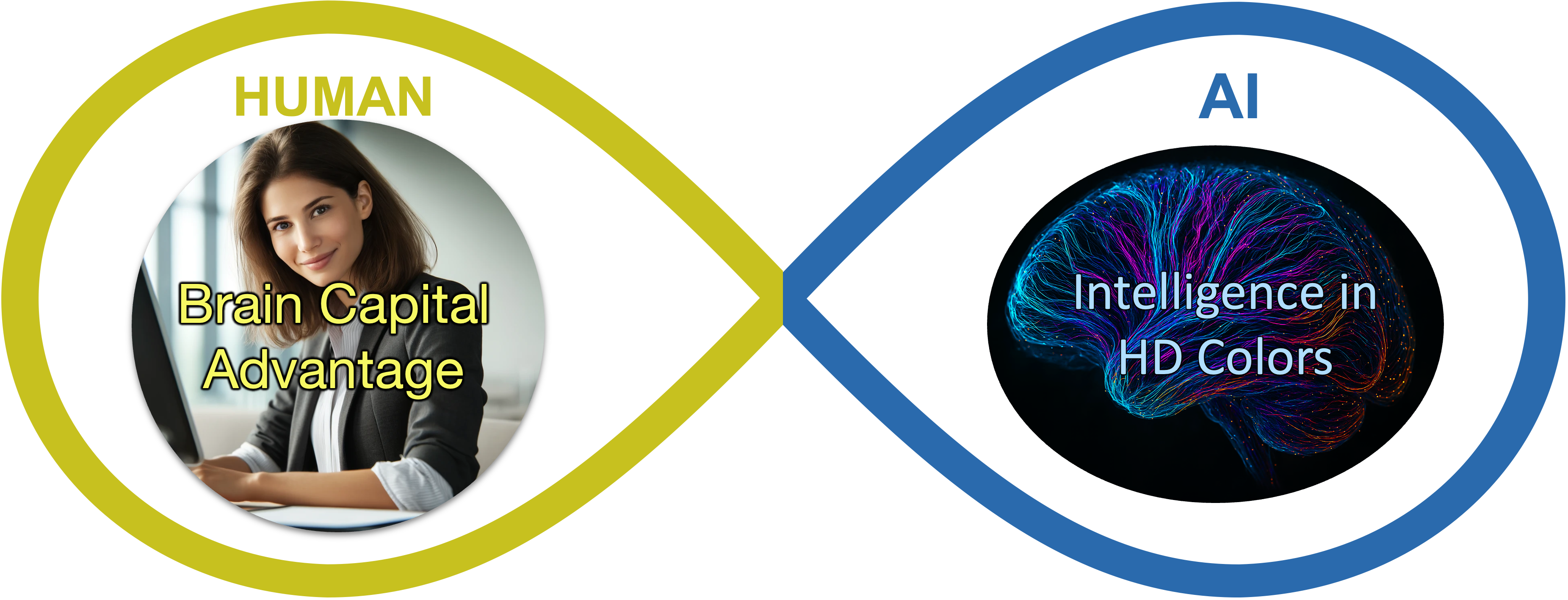
The balance between human intelligence and AI

A · Delayed response

The first failure is to wait for certainty. The signals are already public, but by the time the shift is undeniable, the window to react has closed.

CNBC · Oct 2025 · Erased
Chegg cuts 45% of staff, blaming the “new realities of AI”
Its stock has lost ~99% since 2021. ChatGPT and AI search erased its core business: the cost of reacting too late.
Read article ↗
Fortune · May 2026 · The clock is real
Microsoft’s AI chief: 18 months to automate white-collar work
The most aggressive public timeline yet for knowledge work, set from inside Big Tech.
Read article ↗
Fortune · May 2026 · The clock is real
A bank CEO: AI will replace “lower-value human capital”
Standard Chartered puts a number on it: ~15% of back-office roles over four years. Not a lab founder; a 160-year-old bank.
Read article ↗

B · Suboptimal balance

The second is the wrong mix. Lean on people running legacy tools, and you stay slow and error-prone. Hand the work to AI alone, and you're fast but rigid, uncreative, and stripped of the human edge.

The Register · May 2026 · Backfire
AI layoffs backfire: cutting staff doesn’t cut it
Gartner: ~80% of firms that cut staff for AI saw minimal return.
Read article ↗
Entrepreneur · 2025 · Backfire
Klarna rehires the agents it replaced with AI
After automating ~700 agents’ worth of work, cost and quality forced humans back.
Read article ↗

C · Crude integration

The third is a crude integration. Even the right mix fails if human and AI aren't paired deliberately, bolted together and hoped for.

Fast Company · Feb 2026 · Punished
Even “AI-first” gets punished: Duolingo −80%
Going AI-first without a model for the human half; the market marked it down, not up.
Read article ↗
More human, less AI

More human, less AI

A crude blend of human and AI

Crude blend

More AI, less human

More AI, less human

Three different mistakes, one shared blind spot: none of them measures the human side.

The Blind Spot: Codification of Human Intelligence

Behind every failure is the same gap: we still can't measure human intelligence.

To understand codification, take two examples: color, and flight.

Color was once purely subjective. One person's red was another person's orange, with no way to be sure they meant the same thing. Then we codified it. Color became wavelengths of light, and every shade got a precise value, captured today as a HEX code. Between red and orange there are now thousands of exact, nameable variations, and every screen on earth renders each one identically. A subjective experience became a precise, shared language.

Flight followed the same path. For centuries it was a bird-watching dream, admired, guessed at, impossible to reproduce. Then the Wright Brothers codified it into aerodynamics. Lift, drag, and thrust became measurable forces, and a dream became an engineering discipline anyone could build on.

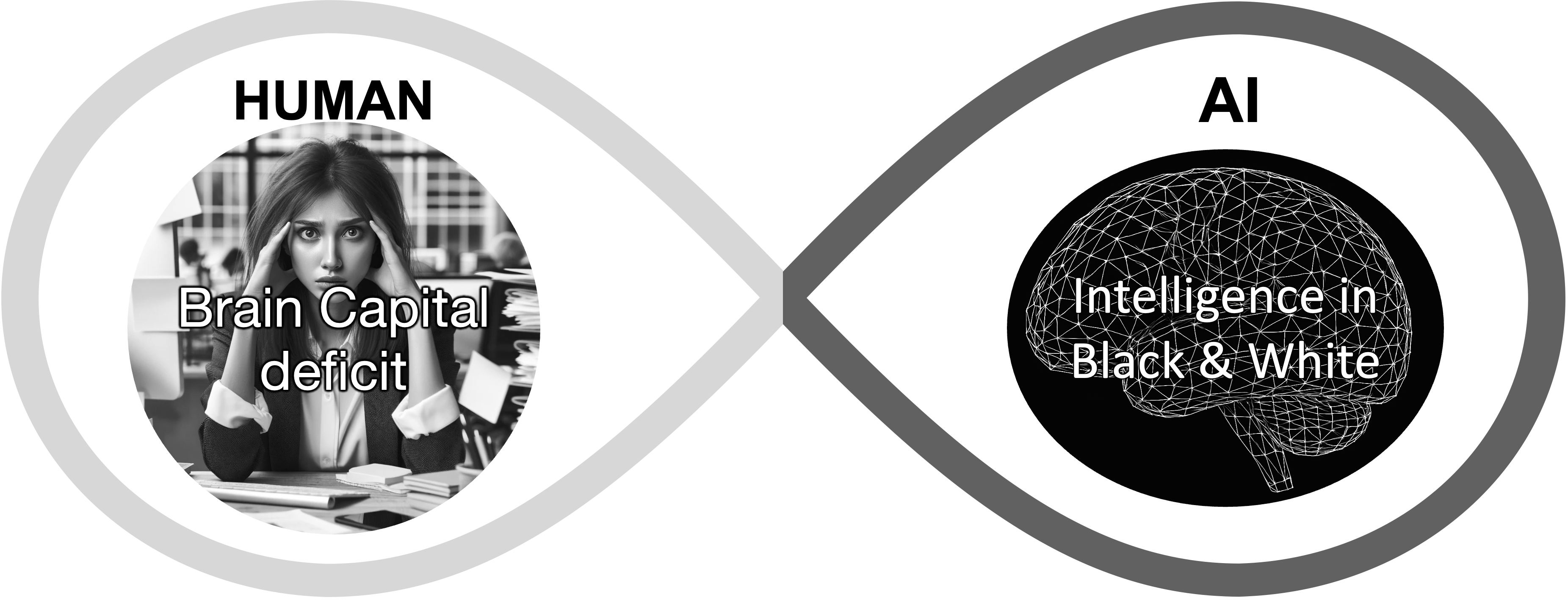
Human intelligence has never had that treatment. It's still where color was before wavelengths: real and powerful, but subjective and unmeasured. So codification is the key.

Intelligence in black and white, the current state

That is the key: codifying human intelligence into quantifiable metrics.

Intelligence in full color, the codified state

The Blueprint

A live, closed-loop system that keeps human and AI in sync.

Once human intelligence is codified, it can finally be paired with AI deliberately. FiLiCiTi's blueprint is a continuous integration model. Human cognitive performance is mapped, measured, and paired with AI over time. Not a one-time assessment, but a live, closed-loop system that adapts as both human and AI capability change. When the human side is measured, well-being drives performance instead of being an afterthought.

The Blueprint, a human and AI integration model

Why FiLiCiTi

The focus, and the safeguards, to do this properly.

This is the one thing FiLiCiTi is built to do. Twenty years of focused work stand behind it, turning the subjective into something quantifiable. And your data stays yours: privacy is built in from the start, never sold, never shared.

Tracks

Select a track to explore further.

🔒 Access Code: Invalid code.

Product

For CHROs, VP People, workforce analytics buyers, and corporate integration partners.

🔒 Enter access code to view

A.1 The 360 Performance Layer

Current corporate tools measure the outside: what employees do (screen monitoring), when they show up (time/attendance). FlowInLife adds the inside: why they performed that way and how to help them improve.

Pillar 1

e.g., ActivTrak
Task-level productivity — the satellite view

Pillar 2

e.g., AI Staff Sync
Attendance & compliance — the ledger

Pillar 3

FlowInLife
Engagement, learning, cognitive readiness — the binoculars

FlowInLife doesn’t replace existing tools. It completes them. Together = genuine 360 feedback.

🔒 Enter access code to view

A.2 Corporate Data Separation

  • 1. Work data only. Period. No personal data enters the corporate stream.
  • 2. Separate accounts. Work email = work data. Personal account = completely separate instance.
  • 3. Keyword-based filtering. Events tagged to projects/teams. Only tagged data flows to team reports.
  • 4. Population-level reporting. Management sees aggregate metrics. Never individual-identifiable.
  • 5. HIPAA-grade privacy. No data shared without explicit consent.
  • 6. Abbott Labs model. Opt-in benefit. Never tied to performance reviews. Never mandated.

“A company cannot give coaching to the employee based on personal data. The company cannot.”

Data Flow Gates

Work → Personal (Coaching Signals)

What Flows:

  • ✓ Learning curve trend (“improving 15%”)
  • ✓ Focus time patterns (“3hrs deep work”)
  • ✓ Productivity trajectory
  • ✓ Flow state frequency

What Does NOT Flow:

  • ✗ Work documents, emails, files
  • ✗ Screen content or screenshots
  • ✗ Manager feedback or reviews
  • ✗ Individual performance rankings

Personal → Work (Population Analytics)

What Flows:

  • ✓ “78% of employees improved well-being”
  • ✓ “Engineering dept. stress trending down”
  • ✓ Aggregated flow state trends
  • ✓ Overall engagement score

What Does NOT Flow:

  • ✗ Individual sleep data
  • ✗ Personal health information
  • ✗ Relationship or family data
  • ✗ Individual coaching conversations

Gate rule: Only metrics and trends cross Work→Personal. Only anonymized, aggregated, population-level metrics cross Personal→Work. Minimum group size ≥5 employees to prevent identification.

🔒 Enter access code to view

A.3 The Learning & Performance Module

“How quick of a learner is each employee? Can the system identify that, and then give coaching so they can be a fast learner?”

What It Measures

  • Learning speed (how fast new skills are acquired)
  • Recall efficiency (how quickly cached knowledge is retrieved)
  • Quality thresholds (perfectionist vs. good-enough patterns)
  • Flow state frequency (stressed, bored, or engaged)
  • AI delegation readiness (which tasks are ripe for AI handoff)

Concrete example: New engineer onboarding. Week 1: AI debrief captures task completion, confidence, time per activity, questions asked — establishes baseline. Week 2: AI compares, identifies what’s improving and what’s stuck, delivers specific coaching. Manager gets anonymized team-level report with benchmarks.

“When a manager gives feedback, employees think: my boss is never going to be happy with me. When an AI gives data-driven feedback, employees say: oh yeah, this makes sense.”

🔒 Enter access code to view

A.4 Data Generation Methods

1. Calendar Sync + Structured Input

Auto-imports work schedule. Employee adds quick context (goals, post-event assessment). Templates pre-fill recurring events.

2. Pattern Learning

App learns work patterns over time. Auto-fills routine events. Manual input decreases progressively.

3. AI Debrief RECOMMENDED

2–3 minute conversational debriefs at natural transition points. AI extracts structured data automatically. Feels like reflection, not data entry. Least employee effort, richest data, removes self-reporting bias.

🔒 Enter access code to view

A.5 Integration & Licensing

  • Per user ID pricing
  • Company pays for work accounts
  • Optional personal account as employee benefit (separate instance, no additional cost)
  • Data integration: FlowInLife → existing HR/performance tools via API
  • Combined dataset creates true 360 view no single product delivers alone

Science

From Description to Engineering — the pattern behind every major scientific revolution.

🔒 Enter access code to view

1. From Description to Engineering

Every major engineering revolution followed the same arc. Millennia of observation. Centuries of misconception. Then a scientific correction, a dimensional breakthrough, an encoding — and an industry worth trillions. Color took five thousand years. Flight took four hundred. The human mind is next.

You cannot engineer what you cannot parameterize. You cannot manufacture what you cannot encode.

Timeline

Observation

Antiquity

Birds fly, objects fall, wind pushes sails

Misconception

1400s

Da Vinci: ornithopters

“Flap like birds.” Wing-flapping machines. Flight is in the flapping — wrong.

Description

1738

Bernoulli

Pressure-velocity relationship. Foundational but not sufficient for control.

1896

Lilienthal: 2,000 flights

Meticulous logs. Still crashed and died. Description alone is not control.

Correction

1799

Cayley: lift ≠ flapping

Fixed wing generates lift. Flight is a force on a surface.

Breakthrough

1901

Wrights: roll, pitch, yaw

3 independent control axes. Wind tunnel, 200+ airfoils. Every orientation = 3 rotations.

Encoding

1903+

Euler angles / quaternions

3–4 values encode any orientation. Basis of all avionics and spacecraft navigation.

Industry

Present

Aviation, aerospace, defense, drones, spacecraft

Observation

~3100 BCE

Egyptian Blue

First synthetic pigment. Still bright 5,000 years later.

~200 BCE

India: 4 primaries

Natya Shastra proposes black, blue, yellow, red. First functional color theory.

603 CE

Japan: ~500 named colors

Prince Shotoku’s color-coded rank system. World’s most granular color taxonomy.

Misconception

~350 BCE

Aristotle & Plato

Aristotle: all colors = white + black. Plato: eye emits light. Both wrong. Dominated 2,000 years.

Description

Thousands of color names across languages and cultures

Correction

1021

Ibn al-Haytham

Book of Optics. Proved light enters the eye. Named the retina. Camera obscura.

~1300

Al-Farisi

Decomposed white light with glass sphere. Newton’s experiment, 350 years early.

1666

Newton

Prism experiment. Spectral analysis. Decomposition is reversible.

Breakthrough

1801

Young: 3 receptors

3 receptor types in retina. Infinite spectrum → 3 dimensions in the observer. Helmholtz confirmed, Maxwell proved.

Encoding

1931

#RRGGBB — 16.7M colors

6 hex digits, 3 pairs. 256×256×256 = 16,777,216 colors. Any screen, identical.

Industry

Present

Cameras, displays, printers, medical imaging, AR/VR

Observation

~3100 BCE

Egypt: 5 parts of the self

Ba, Ka, Ib, Sheut, Ren. First dimensional model of the mind.

~200 BCE

India: 8 rasas

8 fundamental emotional states. 2,200 years before Ekman.

~400 BCE

Greece: 4 temperaments

Hippocrates: sanguine, choleric, melancholic, phlegmatic.

1100s

Japan: Zen protocols

Systematic mental state observation. EEG validated in 1966.

Misconception

1641

Descartes: mind ≠ science

Mind immaterial, unmeasurable. Psychology orphaned from physics for 300 years.

Description

1936

Allport: 18,000 words

Every word describing a person. Equivalent of “infinite colors.”

1980s

Big Five

Five labels. Egyptians had five, 5,000 years ago. Words, not dimensions.

Correction

1994

Crick: The Astonishing Hypothesis

“You — your joys and sorrows — are nerve cells.” Monism replaces dualism.

2025

Behavioral wind tunnels

Shehata, JNeurosci cover (Nov 2025). The measurement framework.

Breakthrough

2023

FiLiCiTi: Mind RGB

Mind RGB [D1 | D2 | … | Dn] — candidate encoding under development. Behavioral data → precise cognitive code.

Encoding

Future

Parameterization of human cognitive dimensions

Industry

Future

Precision mental health, cognitive interfaces, human-AI alignment

I. The Story of Flight

Observation. Birds fly. Objects fall. Wind pushes sails. Every culture observed aerodynamic phenomena for millennia.

Misconception. “Flap like birds.” For centuries, the dominant approach was ornithopters — mechanical wings that mimic bird flight. Da Vinci sketched elaborate flapping machines. People jumped off cliffs with feathers glued to their arms. The assumption: flight is in the flapping.

Scientific correction. Bernoulli (1738) described the pressure-velocity relationship in fluids. Cayley (1799) separated lift from thrust and showed that a fixed wing generates lift — flight is not flapping, it is a force on a surface.6 Lilienthal flew over 2,000 glider flights with meticulous logs — and still crashed and died (1896), because description alone is not control.

Dimensional breakthrough. The Wright brothers (1901) stopped copying birds and asked: what are the independent control variables of a body moving through air? They identified three axes — roll, pitch, and yaw. Every orientation of an aircraft is a combination of three independent rotations.7

Encoding. Euler angles and quaternions — three or four values that encode any orientation in space. The mathematical basis of all avionics, autopilot systems, and spacecraft navigation.

Industry. Before parameterization: fatal glider crashes, failed ornithopters. After: aviation, aerospace, defense, drones, spacecraft — a multi-trillion-dollar ecosystem.

II. The Story of Color

Observation. Every civilization could see millions of colors. Egyptian artisans created the first synthetic pigment, Egyptian Blue, around 3100 BCE — a recipe so stable the color remains bright five thousand years later.1 India’s Natya Shastra (~200 BCE) proposed four primary colors. Japan developed nearly 500 individually named traditional colors across centuries of aesthetic refinement.2

Misconception. Aristotle (~350 BCE) declared all colors are mixtures of white and black — a one-dimensional model of an infinite phenomenon. His teacher Plato believed the eye emits light outward, like a lantern. Both wrong. These ideas dominated Western thought for two thousand years.

Scientific correction. Ibn al-Haytham, working in Cairo under house arrest (1021), published the Kitāb al-Manāżir (Book of Optics) and proved that vision occurs because light enters the eye — reversing 1,500 years of Greek thinking.3 He named the retina, the cornea, and built the first camera obscura. Around 1300, al-Farisi demonstrated the decomposition of white light into colors using a glass sphere — Newton’s prism experiment, 350 years early.4 Newton (1666) systematized spectral analysis and showed decomposition is reversible.

Dimensional breakthrough. Thomas Young (1801) asked the right question: if the spectrum is infinite, and the answer is in the retina, then what is in the retina? He proposed just three receptor types. The infinity of the visible world collapses to three dimensions the moment it enters the eye.5 Helmholtz confirmed it through color-matching experiments. Maxwell proved it mathematically.

Encoding. Engineers built the HEX code: #RRGGBB — six hexadecimal digits, three pairs, each encoding one RGB channel (0–255). That is 256 × 256 × 256 = 16,777,216 colors. Any color, any screen, any device — identical.

Industry. Before trichromacy: black-and-white photography, monochrome television. After RGB: color television, digital cameras, printers, medical imaging, AR/VR — a multi-trillion-dollar ecosystem. The science came first. The engineering came second. The industry came third.

III. The Story of the Mind

In both cases, the breakthrough was never about collecting more observations or writing better descriptions. It was about asking the dimensional question — what are the fundamental, independent axes of this phenomenon? — and building the right measurement tool to answer it. Helmholtz built color-matching apparatus. The Wrights built a wind tunnel. The tool came before the answer.

🔒 Enter access code to view

2. The Unsolved Problem

The human mind follows the same pattern — but is stuck between scientific correction and dimensional breakthrough.

Observation. Emotions, decisions, personality, cognitive states — every culture sees behavioral diversity. Egypt (~3100 BCE) proposed five parts of the self: Ba (personality), Ka (life force), Ib (emotion), Sheut (shadow), Ren (identity).8 India’s Natya Shastra (~200 BCE) proposed eight rasas — fundamental emotional states — 2,200 years before Ekman proposed six basic emotions in the West.9 Greece gave us four temperaments. Japan developed systematic protocols for observing mental states through Zen practice since the 12th century.10

Misconception. Descartes (1641) declared the mind immaterial — unmeasurable by science. The body could be studied; the mind was relegated to philosophy and religion. Psychology was born orphaned from physics. This separation set back behavioral science by three hundred years.11

Centuries of description. Allport (1936) opened a dictionary and counted every word that describes a person: 18,000.12 That is the equivalent of Newton staring at the rainbow and concluding: infinite colors. True. Completely useless for building anything. Decades later, psychologists narrowed it to the Big Five (1980s) — five trait labels. The Egyptians had five, five thousand years ago. But these are words, like the color name “crimson” — not dimensions. They cannot combine to reconstruct the full spectrum.

Scientific correction. Francis Crick (1994), the man who cracked the DNA code, wrote The Astonishing Hypothesis: “You — your joys and sorrows, your memories and ambitions, your sense of identity and free will — are nothing more than the behavior of nerve cells.”13 Descartes was wrong. The mind is physical. Measurable. Neuroscience replaces dualism.

We built rockets to Mars. We sequenced the human genome. We still do not understand who we are.

Where we are now: We have the equivalent of Newton’s prism — fMRI and EEG show that the spectrum exists. But nobody has found Young’s three receptors. The fundamental dimensions of human behavioral experience remain unknown.

The Arc — Three Problems, One Pattern

Step Flight Color Mind
Observation Birds fly, objects fall, wind pushes Millions of colors visible to every civilization Emotions, decisions, personality — every culture sees behavioral diversity
Misconception “Flap like birds.” Ornithopters, cliff jumps with feathers Aristotle: white + black. Plato: eye emits light. Dominated 2,000 years Descartes: mind is immaterial, unmeasurable. Psychology orphaned from physics for 300 years
Description Bernoulli’s equation, Cayley’s fixed wing, Lilienthal’s 2,000 flights Egyptian pigments, India’s 4 primaries, Japan’s 500 color names Egypt’s 5 parts of self, 8 rasas, 4 temperaments, Allport’s 18,000 words, Big Five
Correction Wrights (1901): stop copying birds. Ask: what are the control variables? Ibn al-Haytham (1021): light enters eye. Al-Farisi (~1300): light decomposes. Newton (1666): prism Crick (1994): mind = nerve cells. Monism replaces dualism
Breakthrough Wrights: 3 axes — roll, pitch, yaw. Every orientation = 3 rotations Young (1801): 3 receptor types. Infinite spectrum → 3 dimensions in the observer ? — UNSOLVED. How many fundamental dimensions?
Encoding Euler angles / quaternions — 3 values encode any orientation HEX #RRGGBB — 6 digits, 16.7M colors Mind RGB [D1 | D2 | … | Dn] — candidate under development
Enabling tool Wright brothers’ wind tunnel (200+ airfoil tests) Helmholtz’s prismatic color-matching apparatus Behavioral wind tunnels (Shehata, JNeurosci cover, Nov 2025)
Industry Aviation, aerospace, defense, drones, spacecraft Cameras, displays, printers, medical imaging, AR/VR Precision mental health, cognitive interfaces, human-AI alignment
🔒 Enter access code to view

3. The Tools and the Path

Moving from scientific correction to dimensional breakthrough requires specific prerequisites. In every case, five conditions had to be met.

Prerequisite Flight Color Mind
Right question “What are the independent control axes of a body in air?” “How many independent variables does the observer need?” “How many fundamental dimensions does the brain use to generate behavior?”
Right tool Wind tunnel — controlled airflow, measured forces on wing shapes Prismatic color-matching apparatus Behavioral wind tunnels — controlled but ecologically valid environments
Prior knowledge Bernoulli: pressure/velocity. Cayley: lift ≠ flapping Ibn al-Haytham: answer is in the retina, not the light Crick/Koch: mind = neural activity. Kandel: memory has molecular basis (Nobel 2000). Real-world neuroscience methodology
Math framework Euler’s rotation theorem — any orientation = 3 independent rotations Linear algebra — color as a point in 3D vector space. Grassmann’s laws Dimensionality reduction, topological data analysis, neural manifold geometry
Validation Does aircraft maintain control using only 3 axes? If yes → parameterization correct Can observer distinguish match from target? If not → encoding is sufficient Two-stage: (1) Mind RGB predicts behavior? (2) Mind RGB labels neural data accurately?

The Enabling Tool: Behavioral Wind Tunnels

Before the Wright brothers achieved flight, the true invention was not the airplane — it was the wind tunnel. A controlled environment where variables could be isolated and measured. Neuroscience faces the same problem: laboratory experiments are too artificial (subjects in MRI tubes playing Pac-Man-level tasks), while real life is too chaotic to measure systematically.

Behavioral wind tunnels sit between these extremes: controlled enough for rigorous science, real enough to capture genuine human behavior. This framework was published as the Journal of Neuroscience cover paper (November 2025).14

The answer to the mind is not in the brain scan. It is in the wind tunnel. Just as the answer to color was not in the light — it was in the eye.

Current Architecture: Input → Process → Output

While the dimensional question remains open, FiLiCiTi is building the measurement infrastructure now — a two-stage pipeline that solves the labeling problem first.

Stage 1: Behavioral → Mind RGB CURRENT

Input: Structured conversation, task performance, audio patterns, video snapshots, self-reported data

Process: Proprietary model analyzes against candidate cognitive dimensions

Output: Mind RGB code — numerical cognitive profile

Stage 2: Mind RGB → Neural Validation FUTURE

Once Mind RGB codes are accurate, use them as labels for EEG/neural data.

The heart rate analogy: “scared → heart rate rises. After enough data, heart rate rise alone → scared.” Mind RGB works the same way.

Output Notation

Mind RGB Code: [ D1: 0.82 | D2: 0.34 | D3: 0.71 | D4: 0.55 | … | Dn: 0.48 ]

Visible: Input methods, output format, feedback examples, integration APIs. Proprietary: Dimension definitions, model architecture, labeling methodology.

🔒 Enter access code to view

4. Competitive Landscape

Every approach below is stuck in the description phase — measuring signals without knowing the dimensions.

Approach Method Limitation
EEG-to-emotion Neural signal → emotion label Labels are imprecise. “Happy” is not engineering-grade.
Facial expression Camera → facial action units → emotion Surface-level. Cultural bias. Not cognitive depth.
Physiological sensing Heart rate, GSR → arousal/valence Two-dimensional. Cannot distinguish cognitive states.
Survey / self-report Questionnaires → scores Subjective, infrequent, biased. 200-year-old technology.
FiLiCiTi (Mind RGB) Behavioral data → precise code → THEN map to neural data Solves the labeling problem first.

Business

For investors, business community leaders, advisors, and peer networks.

🔒 Enter access code to view

C.1 The Market Opportunity

Every company is adopting AI. Most are doing it wrong — either laying off people or misallocating human vs. AI tasks. Nobody has a framework for understanding what the human brain actually does better than AI.

FiLiCiTi is the only company approaching human-AI integration from neuroscience. Not another AI tool. The layer that makes AI adoption work for humans.

⚠️
FLAG 2: 10X PRODUCTIVITY CLAIM — UNSUBSTANTIATED

This claim was stated twice on recorded calls (March 4 broadcast + post-broadcast). It requires a specific example or data point before further use. Do not repeat without substantiation.

🔒 Enter access code to view

C.2 Business Model

  • Model: B2B2C. Contract with organization, org deploys to employees.
  • Pricing: $15–25/employee/month at commercial scale.
  • Design partner pricing: Performance-based (0% improvement = free; tiered above).
  • Minimum: 50+ employees preferred for population analytics. 10+ for pilots.
🔒 Enter access code to view

C.3 Traction & Milestones

Milestone Status
App developmentBeta 3 (2 years)
User testing~50 participants
AI layerAlpha, building
Design partnersActively seeking (target: 3)
Commercial launch~May 2026
Design partner → contractTarget: July 2026
RevenueTarget: End of 2026
🔒 Enter access code to view

C.4 The Human Edge Positioning

“Instead of laying off people, you 10X productivity with the same team.”

⚠️
FLAG 1: VALUE PROPOSITION STATEMENT — PENDING

This is the gating item before AMCOB introductions can proceed. Kashif will not make introductions until this is delivered. Must be: concise, business-owner-friendly, includes measurable value, not technical.

⚠️
FLAG 2: 10X PRODUCTIVITY CLAIM — UNSUBSTANTIATED

This claim was stated twice on recorded calls (March 4 broadcast + post-broadcast). It requires a specific example or data point before further use.

Supporting concept — Brain Capital: Human brains are a capital asset. They have architecture (RAM, caching, processing speed). That architecture can be measured, optimized, and integrated with AI. Companies that understand their brain capital will outcompete those that don’t.

The proactive AI reversal: Most people know AI as “you ask, it answers.” FlowInLife reverses this: the AI asks YOU. “What did you do? Why? How did it go?” This is the reflection loop that generates the data.

Competitive Positioning Map

9 competitors plotted on Objective↔Subjective (X) vs Performance↔Well-being (Y). FlowInLife uniquely spans both quadrants via dual-product architecture.

Objective + Well-being Subjective + Well-being Objective + Performance Subjective + Performance Subjective Objective Well-being Performance YutaAI Bridge Joye Personos BetterUp Humu Firstbeat CardioMood Worxogo WalkMe Pendo FlowInLife Personal FlowInLife Work (AI Workflow Platform)

FlowInLife Personal sits in Objective+Well-being; FlowInLife Work spans Objective+Performance (app-native AI interaction signals) with Phase 2 adding sensorimotor depth. YutaAI bridges both without exposing personal data to employers. No competitor spans both quadrants.

🔒 Enter access code to view

C.5 Fundraise

  • Raising: $1.5M
  • Minimum check: $25K
  • Current investors: Angel investor (existing)
  • Use of funds: Commercial launch, design partner onboarding, AI layer completion
  • Philosophy: Smart money + aligned beliefs. Investors become partners, not just funders.
🔒 Enter access code to view

C.6 Community Alignment

FiLiCiTi helps community businesses become so competitive that economic value naturally stays within the community. Not through obligation — through quality.

“I don’t think about the exit. I think about how much impact I’m going to bring to people.”

Research

For academic collaborators, research institutions, and co-investigators.

🔒 Enter access code to view

D.1 Scientific Foundation

Research trajectory: Genetics → cell biology → rodent models → human neuroimaging → computational neuroscience → applied cognitive architecture.

The gap: Psychology’s categorization of mental states (happy, sad, focused, stressed) is literature, not physics. These labels cannot be precisely quantified, reproduced, or computed.

The insight: The problem is not in data collection (better EEG, better fMRI). The problem is in data labeling. Define WHAT you’re measuring with engineering precision, THEN measure it.

🔒 Enter access code to view

D.2 The Parameterization Thesis

Core claim: Human cognition can be reduced to a finite set of fundamental dimensions (analogous to R, G, B for color) that are sufficient to reconstruct the full spectrum of cognitive states.

  • Dimensions derived from cognitive architecture, not self-report
  • Tractable number (not three, not billions)
  • Each dimension independently scorable
  • Framework is testable and falsifiable

Extends beyond dimensional emotion models (Russell’s circumplex, Ekman’s basic emotions). Draws from psychophysics. Computational: designed to be machine-readable from inception.

🔒 Enter access code to view

D.3 Current Research

Stage 1 validation (behavioral → Mind RGB): Beta 3 app, ~50 participants, 2 years. Behavioral data collection and cognitive profiling operational.

Stage 2 (Mind RGB → neural mapping): Planned, not yet tested. Requires hardware partner for consumer-grade neural data collection.

🔒 Enter access code to view

D.4 Collaboration Opportunities

  • 1. Data labeling methodology validation (independent replication of Mind RGB coding)
  • 2. Cross-modal mapping studies (behavioral → EEG → ultrasound)
  • 3. Longitudinal cognitive profiling (how Mind RGB codes change over time)
  • 4. Population-level cognitive architecture patterns (cross-cultural, cross-age)
  • 5. AI-human task allocation optimization (empirical “human edge” testing)

🔒 Partner Q&A

Enter your partner access code to view your personalized Q&A section.

🔒 Access Code: Invalid access code.

Feroze Hanif — AI Staff Sync

March 13, 2026 | ~49 min | Track A alignment | 17 exchanges

QA01 — Product name clarification
FiLiCiTi is the company. FlowInLife is the product — the app employees use. MINDGEM is the reflection framework. MindRGB is the underlying science.
QA02 — 360 feedback framing
Feroze framed FlowInLife as “the third component” for a full 360 feedback: ActivTrak (what they did) + AI Staff Sync (when they showed up) + FlowInLife (why they performed that way). This is Feroze’s own framing.
QA03 — Dashboard demo
The dashboard shows the satellite view (big picture productivity) vs. the binoculars (individual cognitive readiness). FlowInLife provides the binoculars that zoom into the individual.
QA04 — Department-level data
Strongest demo moment: “Design team is stressed, goals going down.” Population-level analytics reveal patterns no individual report could. Management sees trends, not individuals.
QA05 — How is data generated?
Three methods: (1) Calendar sync + structured input, (2) Pattern learning over time, (3) AI debrief — 2-3 minute conversational debriefs. Method 3 is recommended for corporate: least burden, richest data, removes self-reporting bias.
QA06 — Privacy: personal vs. work data
Keyword-based filtering is SETTLED architecture. Events tagged to projects/teams. Only tagged data flows to team reports. Personal data never enters the corporate stream. Two separate accounts, two separate instances.
QA07 — Privacy: work hours only
Corporate deployment captures work-related activities only. Dual-account model designed from the ground up. HIPAA-grade privacy. Work email = work data. Personal account is a completely separate instance with no data crossover.
QA08 — Licensing model
Per user ID. Company pays for work accounts. Optional personal account offered as employee benefit — separate instance, no additional cost to employer. Integration via API with existing HR/performance tools.
QA09 — Abbott Labs: opt-in well-being
FOUNDATION of corporate design. Population-level reporting to employer. Individual data stays private. Opt-in benefit, never tied to performance reviews, never mandated. Abbott Labs model: “A company cannot give coaching to the employee based on personal data.”
QA10 — Work environment configuration
Design partner framing: we co-design the corporate configuration with the partner. Work-only mode, department tagging, integration points — all customized during the pilot phase.
QA11 — Learning speed identification + coaching
STRONGEST ALIGNMENT with Feroze. FlowInLife identifies how quick a learner each employee is, then delivers AI coaching so they improve faster. Learning curves per person. The “human edge” framing backed by PhD-level cognitive science.
QA12 — Onboarding + continuous coaching
The Employee Learning & Performance module: measures learning speed, recall efficiency (human caching), quality thresholds, flow state frequency, AI delegation readiness. Concrete example: new engineer, Week 1 baseline, Week 2 comparison, specific coaching, anonymized team benchmarks.
QA13 — AI coaching vs. manager feedback
KEY INSIGHT: “When a manager gives feedback, employees think: my boss is never going to be happy with me. When an AI gives data-driven feedback, employees say: oh yeah, this makes sense.” AI coaching removes the power dynamic. Employees trust data over bosses.
QA14 — Personal + work data connection
The connection exists through YutaAI (server-side AI that sees both streams, encrypted, not employer-accessible). But the corporate boundary is absolute: employer never sees personal data. Only population-level signals cross (“employees are improving”).
QA15 — Focus corporate side next meeting
CLEAR DIRECTION from Feroze: corporate-only demo for next meeting. Focus on learning analysis, work-only configuration, integration architecture with ActivTrak + AI Staff Sync.
QA16 — Personalized learning curves
AI debrief extracts learning curve data automatically from 2-3 minute conversations. Shows improvement trajectory per employee over time. Manager sees anonymized team benchmarks, not individual data.
QA17 — Next meeting: bring team, share recording
Three commitment signals: (1) Feroze shares recording with team, (2) team prepares questions/use cases, (3) next meeting is team evaluation. Strong forward momentum.

Closing Commitments

  • Feroze shares recording with team
  • Team prepares questions/use cases
  • Next meeting: corporate-focused demo (learning analysis, work-only config, integration architecture)
  • Feroze + team attend next meeting

Canon Medical — Follow-Up

Following our March 11, 2026 discussion with Dr. Hirakawa, Yano-san, and Nishimura-san.

Download Print Version (PDF-ready)

Summary

FiLiCiTi is building the RGB of human cognition — a fundamental framework that parameterizes cognitive states the way RGB parameterizes color. The core insight: the bottleneck in brain-computer interfaces is not sensor hardware or AI models. It is data labeling. Psychology’s categories (“happy,” “focused”) are too imprecise for engineering. FiLiCiTi solves the labeling problem first, then maps those labels to neural data.

Dr. Hirakawa summarized it clearly: “FiLiCiTi converts external behavioral signals into a standardized cognitive code. Once this is done, almost all cognitive states can be represented as a reproducible signal compatible with AI.”

How Mind RGB Works

Input

Structured cognitive assessments, interaction patterns (response latency, word choice, self-corrections), and context data (time, task type, break patterns).

Process

Proprietary intelligence model analyzes inputs against fundamental cognitive dimensions. Not emotion labels — cognitive architecture.

Output

Mind RGB Code — a numerical cognitive profile. Machine-readable, reproducible, precise enough to serve as training labels for neural data.

Mind RGB Code: [ D1: 0.82 | D2: 0.34 | D3: 0.71 | D4: 0.55 | … | Dn: 0.48 ]

Why This Is Different

Approach Method Limitation
EEG-to-emotion Neural signal → emotion label Labels are imprecise. “Happy” is not engineering-grade.
Facial expression Camera → action units → emotion Surface-level. Cultural bias. Not cognitive depth.
Physiological sensing Heart rate, GSR → arousal/valence Two-dimensional. Cannot distinguish cognitive states.
FiLiCiTi (Mind RGB) Behavioral data → precise code → then map to neural data Solves the labeling problem first.

The Partnership Model

FiLiCiTi Brings

The intelligence layer. Cognitive model, labeling methodology, AI feedback system. Defines WHAT data to collect and HOW to interpret it.

Canon Brings

The hardware layer. Sensor precision, optical engineering, miniaturized form factor. 90 years of mastering how humans see — now extended to how humans think.

Neither can build the product alone. The vision: lightweight smart glasses with integrated EEG, eye tracking, and camera — powered by real-time Mind RGB computation. A device that does not just see the world, but understands the person using it.

Proposed Next Steps

Step Description Timeline
1. Document review Review this document and the Science track for technical detail. At your pace
2. Technical discussion Deeper session on Mind RGB methodology, two-stage pipeline, and sensor requirements. Propose after review
3. Joint exploration Define scope of a design-stage collaboration: what data to collect, what hardware form factor, what labels to validate. To be discussed

Kashif Ahmed — AMCOB Spotlight

March 4, 2026 | LinkedIn & YouTube Live + Post-Broadcast | Track C alignment | 22 exchanges

Broadcast Section (Public-Facing)

QA01–05 — Pre-broadcast prep
Format awareness, audience calibration. LinkedIn & YouTube Live format with ~100K newsletter reach. Community business leaders as primary audience.
QA06 — Origin story
PhD Neuroscience. Studied under postdoc of Nobel laureate Eric Kandel. Research in Japan, then Caltech since 2016. Founded FiLiCiTi 2022 after seeing AI disruption and realizing academic papers weren’t reaching people’s lives.
QA07 — Company focus / 2022 start
“Instead of laying off people, you 10X productivity with the same team.” AI as partner, not replacement. Brain capital as competitive advantage.
QA08 — Cognitive skills improvement
Human brains have architecture: RAM (working memory), caching (recall efficiency), processing speed. That architecture can be measured, optimized, and integrated with AI. Like tuning a high-performance engine.
QA09 — Product description
Three-layer system: Reflection (MINDGEM) → Optimization (AI coaching) → Delegation (AI handles what humans shouldn’t waste cognitive resources on). FlowInLife Work IS the delegation surface — the AI workflow platform where humans and AI co-evolve. A cognitive operating system, not a life coach.
QA10 — Work vs. life scope
Dual-product: FlowInLife Work (AI workflow platform, corporate) + FlowInLife Personal (mobile, individual). YutaAI bridges both. “The human being is one thing” — but employer and personal data stay separate.
QA11 — B2C vs. B2B / design partners
Inside-out approach (understand the person first) vs. competitors’ outside-in (monitor behavior). B2B2C model: contract with org, org deploys to employees. Design partners get performance-based pricing.
QA12 — Privacy
Direct and confident: HIPAA-grade, therapist-level privacy. No data sold. Dual accounts. Population-level reporting only. Opt-in benefit, never mandated.
QA13 — Timeline
“App live in two months” — public commitment on broadcast with ~100K reach. Target: approximately May 2026. Track against this.
QA14 — Anti-layoff message
STRONGEST go-to-market message for this community: “Instead of laying off people, you 10X productivity with the same team.” Positions FiLiCiTi as the alternative to layoffs.
QA15 — Personal interests
Light touch. Brain-fitness connection. The science behind personal optimization applies to every aspect of life, not just work.
⚠️
FLAG 2: 10X PRODUCTIVITY — stated on this broadcast (QA07) and repeated post-broadcast (QA20). Requires substantiation.

Post-Broadcast Section (Private, Strategic)

QA16 — Kashif interested in FiLiCiTi for AMCOB
Design partner lead. Kashif expressed interest in using FlowInLife for AMCOB member businesses. Follow up with tailored proposal.
QA17 — Pricing model
Per-employee subscription + token overage for AI interactions. Clean and simple. Aligned with design partner framework.
QA18 — Pricing ceiling
$15–25/employee/month on record. Performance-based for design partners (0% improvement = free).
QA19 — Minimum employees
50+ employees preferred for population analytics (meaningful aggregate data). 10+ acceptable for pilots.
QA20 — 10X claim repeated
Claim repeated in private conversation. Must be substantiated with specific example or data point before further use. Now public record on LinkedIn and YouTube.
QA21 — Exit plan
“I don’t think about the exit. I think about how much impact I’m going to bring to people.” Long-term value creation with structured liquidity events for investors. The mission stays.
QA22 — Fundraise details
Raising $1.5M. $25K minimum check. Angel investor already in. Revenue target: end of 2026. Smart money + aligned beliefs required.

Kashif’s Commitments

  • Natasha outreach for investor visibility (newsletter + website)
  • Investor introductions (calibrated to check size)
  • Design partner intros: restaurant chain (50-75 office), tech company (1,000 employees)
  • Chicago private retreat invitation (June, 40 people)
  • Dallas conference speaking slot (September)
  • Post-Eid discussion on contributing to AMCOB growth

AMCOB Peer Advisory

March 9, 2026 | 4:00 PM PT | Attendees: Kashif, Noor Hamid, Tariq Islam, Yahia Dajani | Track C alignment | 12 exchanges

QA01 — ICP definition
Ideal Customer Profile: 50-100 employees, department or whole company. Companies adopting AI that need to understand their human workforce’s cognitive architecture. Kashif’s cleaner reframe adopted.
QA02 — ICP refinement by Kashif
Kashif summarized better than initially stated: companies with enough employees for meaningful population analytics, in industries where human cognitive performance directly impacts business outcomes.
QA03 — “Any other questions?”
Missed opportunity to proactively share proof points and traction. Next time: always have 2-3 concrete data points ready to volunteer.
QA04 — Contract-before-pilot structure
CRITICAL CORRECTION: contract signed BEFORE pilot begins, not after. Demonstrates business clarity. Performance-based pricing still applies — but terms are agreed upfront.
QA05 — Direct approach vs. power partners
Honest response: “Give me more details.” Open to both direct outreach and warm introductions through power partners (accountants, insurance, consultants).
QA06 — Power partner categories
KASHIF’S CORE STRATEGIC CONTRIBUTION. Five power partner categories: accountants, insurance companies, consultants, HR service providers, technology vendors. Each has existing trust with target companies.
QA07 — 5×5 framework
5 power partner categories × 5 contacts each = 25 warm paths to design partners. Concrete and actionable. Needs specific names mapped to each category.
QA08 — AMCOB LinkedIn group
600+ members. Warm path-finding tool for identifying qualifying companies within the community network.
QA09 — Database: 100+ qualifying companies
“I need three. Only three.” Clear design partner target. 100+ qualifying companies in the database means the funnel is wide enough.
QA10 — 3-5 personal introductions
MAJOR COMMITMENT from Kashif. Conditional on value proposition delivery. Will not make introductions without it.
QA11 — Value proposition as gating item
THIS IS THE GATING ITEM. Must be: concise, business-owner-friendly, includes measurable value, not technical. Kashif explicitly conditioned introductions on receiving this first.
QA12 — “Land the top name first”
Same advice given to Noor. Target: one recognizable brand as first design partner. Creates case study credibility for all subsequent conversations.
QA13 — Stagger design partners by priority
NOOR’S ADVICE (directly applicable from same session): “Find one you don’t care about first. Make your mistakes there.” Even if targeting 3 design partners, do NOT start all at once. Sequence: Tier 1 (practice, low stakes) → Tier 2 (real ICP targets) → Tier 3 (marquee brand). Looking back at early outreach, you always wish you had waited until better prepared. The onboarding script, KPI agreement, and coaching setup will all need refinement — do that cheaply first.
QA14 — Don’t burn marquee leads early
YAHIA’S ADVICE: “You don’t want to burn your cards in the beginning. Always better to go with the small ones. Test yourself. See their feedback, it will help you improve. By the time you get better, then you go after the real clients.” Applied directly: do NOT approach Kashif’s restaurant chain (50-75 office) or tech company (1,000 employees) introductions until Tier 1 pilot is complete and documented. Save the best leads for when you have proof of concept.
FLAG 1: VALUE PROPOSITION STATEMENT — RESOLVED. Ready to send to Kashif.

One-liner (text to Kashif): “FlowInLife identifies what your knowledge workers can safely delegate to AI and where human performance needs protecting — delivering measurable team gains in 60 days, contract signed upfront, or the pilot is free.”

Full version (design partner meeting): Every company adopting AI faces the same blind spot: they don’t know the cognitive performance of their own team — what can be safely handed to AI, what human judgment must stay protected, and what’s silently limiting output. FlowInLife closes this gap. In 60 days, your leadership gets a cognitive performance baseline for your department: AI delegation zones mapped, bottlenecks surfaced, targeted coaching delivered — all without exposing individual data to management. Performance-based contract signed before we start. If we don’t move your KPIs, you pay nothing.

For power partners (accountants, consultants, etc.): “I help the companies you work with identify their AI readiness — which tasks are safe to automate and where they need to protect human performance. Zero-risk 60-day pilot, contract signed before we start. Looking for 3 design partners in companies you already advise.”

Mo’s Deliverables — Kashif Meeting March 19

  • ✓ DONE — Value proposition statement (one-liner + full version)
  • Text Kashif value proposition one-liner + confirm meeting logistics
  • Log into AMCOB database — confirm access and identify 3 Tier-1 candidates
  • Power partner 5×5 list — minimum 2–3 names per category to present
  • Send 5 LinkedIn connection requests to AMCOB members (start warm path)
  • Review Kashif’s 3 sales documents shared on AMCOB Slack (Saturday)

Kashif’s Additional Commitments

  • COMMIT-01: AMCOB member database access (by end of that week)
  • COMMIT-02: Connect with accountants, insurance companies (power partners)
  • COMMIT-03: Member portal launch (by end of that week)
  • COMMIT-04: Go-to-market strategy paper from Kashif
  • COMMIT-05: Natasha follow-up confirmation
  • COMMIT-06: Mohammad’s spotlight in AMCOB newsletter next month